How Much Money Should You Leave in Checking After Bills?
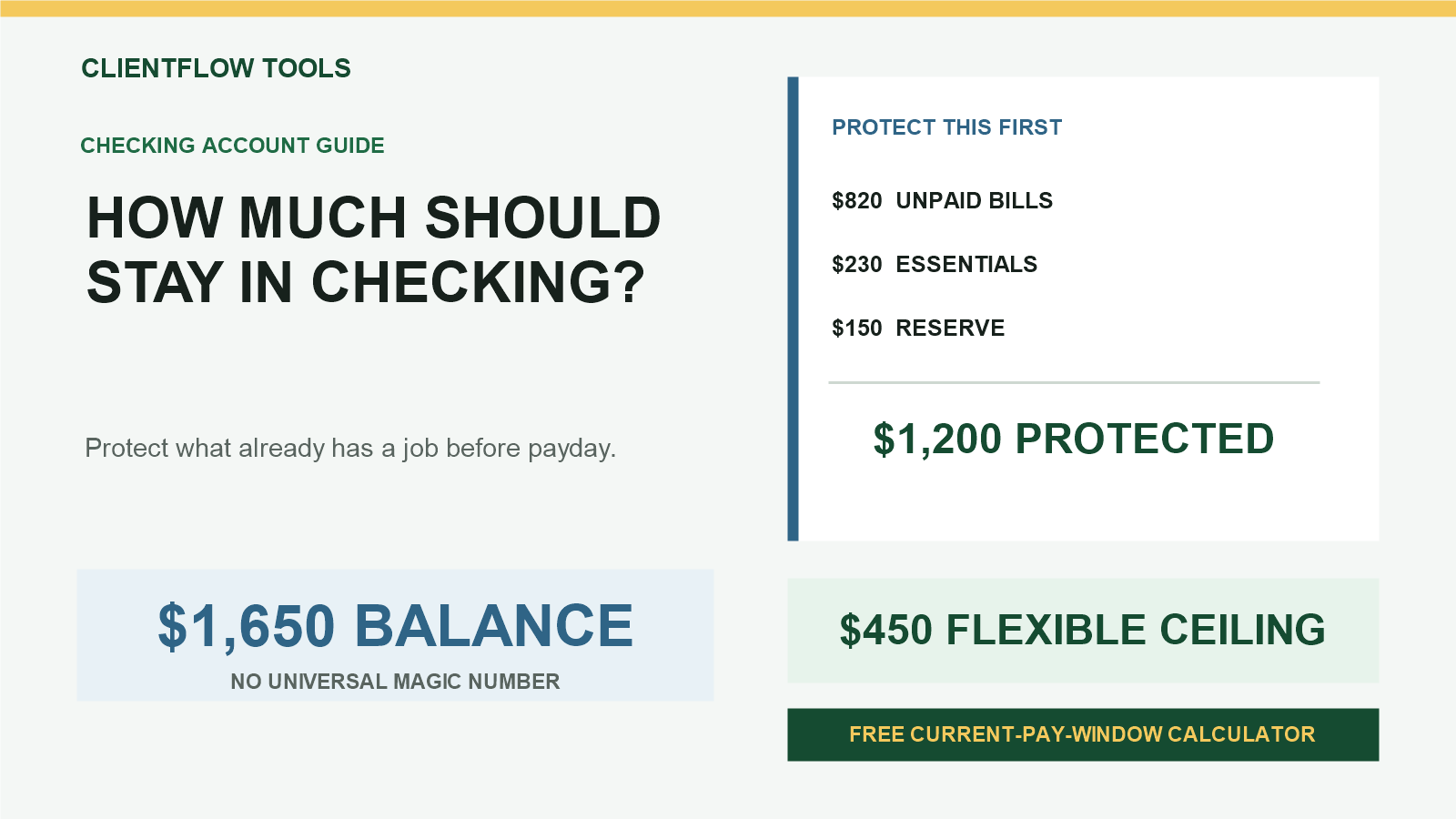
How much money should stay in checking after payday: $500, one paycheck, or a full month of expenses?
There is no universal dollar amount. The useful number is what must remain available for obligations that have not happened yet.
Want your current number?
Use the free paycheck budget calculator. Enter the available balance, unpaid bills due before payday, remaining essentials, and a reserve. No signup or bank connection is required.
Use the amount that already has a job
Start with this current-pay-window formula:
Amount to protect = unpaid bills + remaining essentials + chosen reserve
Safe-to-spend estimate = available balance - amount to protect
The reserve can include a bank-required minimum balance or a small personal cushion. Do not also list the same amount as a bill, or it will be counted twice.
A clear $1,650 example
Suppose the bank's available balance is $1,650 and the next paycheck is still several days away:
| Available balance | $1,650 |
| Unpaid bills due before payday | -$820 |
| Groceries, transport, and other essentials still needed | -$230 |
| Reserve left untouched | -$150 |
| Flexible ceiling | $450 |
In one line: $1,650 - $820 - $230 - $150 = $450.
At this moment, $1,200 should remain protected. That is not a permanent checking-account minimum. It is the total that still has a job before payday. As a bill clears or an essential purchase is completed, update both the balance and the remaining obligation so the same money is not subtracted twice.
Why a fixed $500 rule can fail
Two people with the same balance can need different floors. One may have rent and insurance scheduled tomorrow. Another may have already paid every bill and use a separate account for emergencies. Income timing, automatic payments, essential costs, account minimums, and personal comfort all change the answer.
Recent budgeting discussions show exactly this spread: some people keep only a few hundred dollars, while others keep one or two months of expenses. The disagreement is a sign that the answer must be based on upcoming obligations, not someone else's preferred balance.
Use the available balance carefully
The Consumer Financial Protection Bureau notes that deposits, withdrawals, and other transactions may not update immediately or in the order expected. Its overdraft guidance recommends tracking the balance and knowing when prescheduled payments will occur.
If a pending card purchase is already reflected in the available balance, do not subtract it again. If an automatic payment has not reduced the available balance yet and is due before payday, include it with unpaid bills.
The CFPB's automatic-payment guidance also recommends monitoring upcoming withdrawals and ensuring enough money is available when each payment is scheduled.
A checking buffer is not the same as an emergency fund
This calculation protects near-term cash flow inside the checking account. It does not determine how large an emergency fund should be, where long-term savings should sit, or whether money should be moved or invested. Those are separate decisions based on access needs, account terms, risk, taxes, and personal circumstances.
What if the result is negative?
A negative result means the current available balance does not cover the amounts entered. It is a shortage warning, not a recommendation about which payment to delay. Verify every amount and date, then contact the relevant biller or qualified support service before a deadline if needed.
Free calculator or bill-by-bill planner?
Use the free calculator when you already know the totals. Use the paid planner when you need to list individual bill names and due dates, assign them across two pay windows, and keep a printable record.
Check the current number with the free live calculator. To sort individual bills across two paychecks, use the Two-Payday Bill Planner.
This article is for general educational organization only. It is not financial, banking, debt, investment, legal, or tax advice. Verify balances, pending transactions, bill amounts, due dates, account terms, and payment processing yourself.


Comments
Post a Comment