How Much Can I Spend Per Day Until Payday? A Simple Check
A bank balance of $980 and a payday 10 days away may look like $98 per day. That shortcut is usually wrong because part of the balance may already be needed for bills, food, transport, medicine, or a reserve.
A useful daily pace starts with a different question: after protecting everything still needed before payday, how much is actually flexible?
Calculate the ceiling before the daily pace.
Use the free paycheck budget calculator. It runs in your browser without a signup, bank connection, or spreadsheet.
Do not divide the whole bank balance
First subtract the money that already has a job:
- Unpaid bills due on or before the next payday
- Essentials still needed before payday
- A reserve you intend to leave untouched
The basic estimate is:
Money available - bills due - essentials remaining - reserve = safe-to-spend ceiling
Only then divide the ceiling by the number of days until payday.
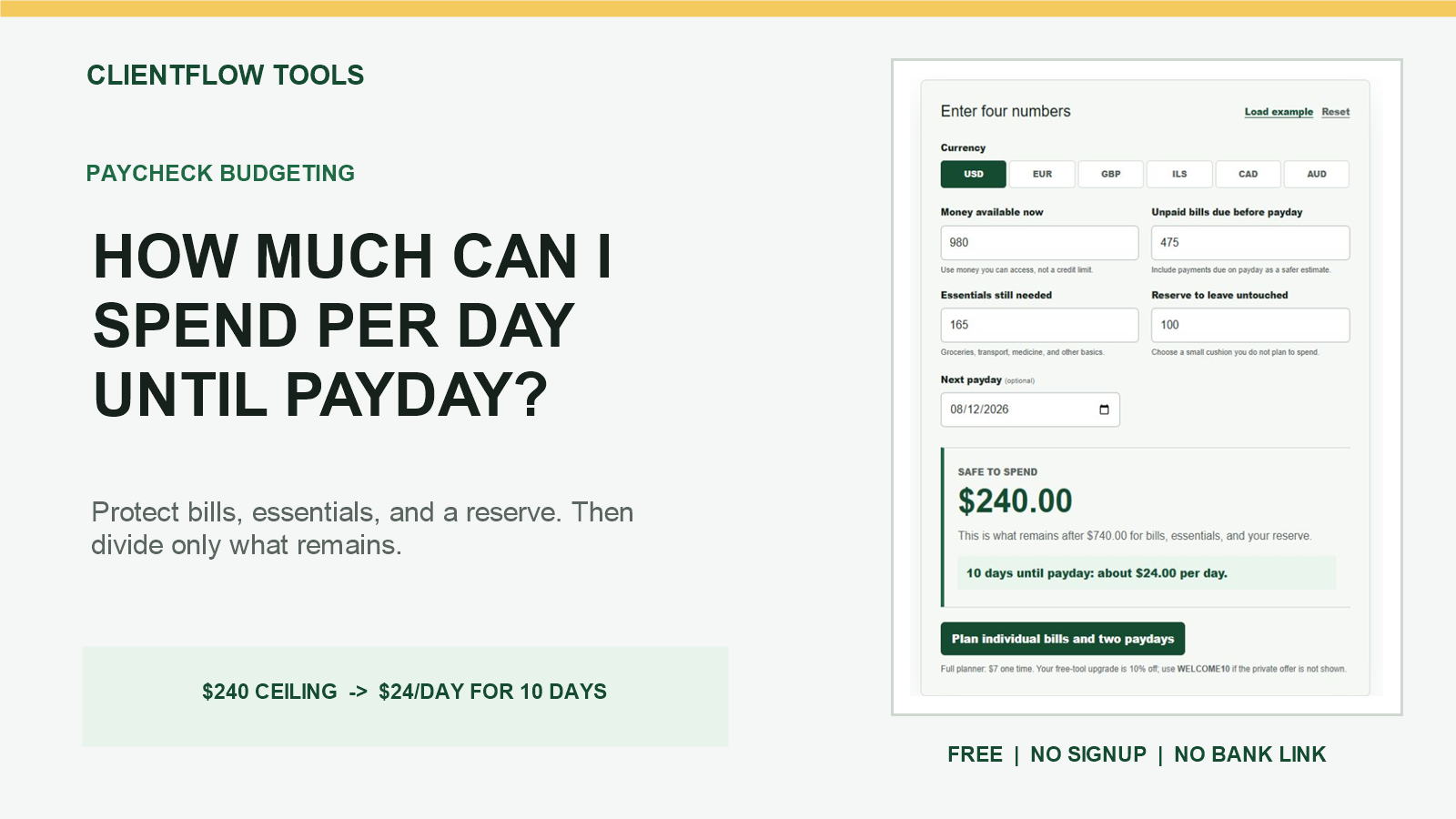
A $980 balance can produce a $24 daily pace
| Money available now | $980 |
| Unpaid bills due before payday | -$475 |
| Essentials still needed | -$165 |
| Reserve left untouched | -$100 |
| Safe-to-spend ceiling | $240 |
If the next payday is 10 days away, $240 divided by 10 is about $24 per day.
That does not mean you should spend $24 every day. It is a check-in pace. A no-spend day leaves more room for a later purchase, and one necessary large purchase may use several days of the pace at once.
Recalculate without counting essentials twice
This is where a simple daily number often goes wrong.
Suppose the original $165 essentials estimate includes $70 for groceries. After buying those groceries:
- Money available falls from $980 to $910.
- Essentials still needed falls from $165 to $95.
- Bills and reserve stay unchanged.
The updated calculation is $910 - $475 - $95 - $100 = $240. The flexible ceiling did not change because the $70 purchase came from money that was already protected for essentials.
If you reduce the bank balance to $910 but leave essentials at $165, the same $70 is subtracted twice. Update both the available money and the remaining essential estimate when a planned essential purchase clears.
A flexible purchase changes the ceiling
Now suppose the $40 purchase was optional and was not included in bills or essentials. Money available becomes $940 while the other inputs stay the same:
$940 - $475 - $165 - $100 = $200
If nine days remain, the new pace is about $22.22 per day. This is why the number should be recalculated after a meaningful flexible purchase instead of treated as a permanent allowance.
A new bill changes both the ceiling and the pace
If an unexpected $50 payment becomes due before payday, bills due rise from $475 to $525. With the original balance and other inputs, the ceiling becomes $190. Over 10 days, that is a $19 daily pace.
The purpose is not to make the estimate look comfortable. It is to surface the changed constraint before more flexible spending happens.
Use actual due dates
Count an unpaid bill in the current calculation when it is due on or before the next payday. A bill due after payday belongs to the next pay window, although it should still remain visible in your broader plan.
The CFPB's bill-calendar guidance recommends listing bills and due dates so the timing is visible. That timing matters here because a monthly total does not show which paycheck must cover each bill.
Check pending transactions before starting
Use the most realistic spendable balance you can confirm. Review card purchases, automatic payments, transfers, and checks that may not have posted. If a pending payment is already excluded from your bank's available balance, do not subtract it a second time.
Bank display rules differ, so verify how your account treats pending activity.
When to run the check again
- After a meaningful optional purchase
- When a bill amount or due date changes
- After unexpected income arrives
- When a planned essential purchase has cleared
- When the number feels inconsistent with pending transactions
Open the free live calculator for the four-total check. If you need to enter individual bill names and due dates, sort them into the current and next pay windows, and save the plan locally, see the Two-Payday Bill Planner.
This article is for general educational organization only. The result is an estimate and a spending ceiling, not a target, guarantee, or financial, legal, tax, debt, or payment recommendation. Verify balances, pending transactions, bill dates, and decisions yourself.


Comments
Post a Comment