How to Budget From Payday to Payday (Instead of Month to Month)
A monthly budget can look fine on paper and still leave you short three days before payday. The problem is often timing, not the monthly total.
A payday-to-payday budget uses the period you actually live through: today through the day your next paycheck arrives. It helps answer a smaller and more useful question: what must this money cover before more income arrives?
Get the number before building the full plan.
Use the free live Safe-to-Spend Calculator. It runs immediately with no signup or bank connection.
Start with one pay period
Write down these five numbers:
- Money available today
- Other income arriving before payday
- Unpaid bills due on or before payday
- Essential spending still needed before payday
- A reserve you do not want to touch
The basic calculation is:
Available money - bills due before payday - essentials - reserve = flexible spending ceiling
The Consumer Financial Protection Bureau describes cash-flow budgeting as tracking when income and expenses happen so you can see whether enough money is available week by week. Its Your Money, Your Goals toolkit includes both bill-calendar and cash-flow-budget resources.
A simple example
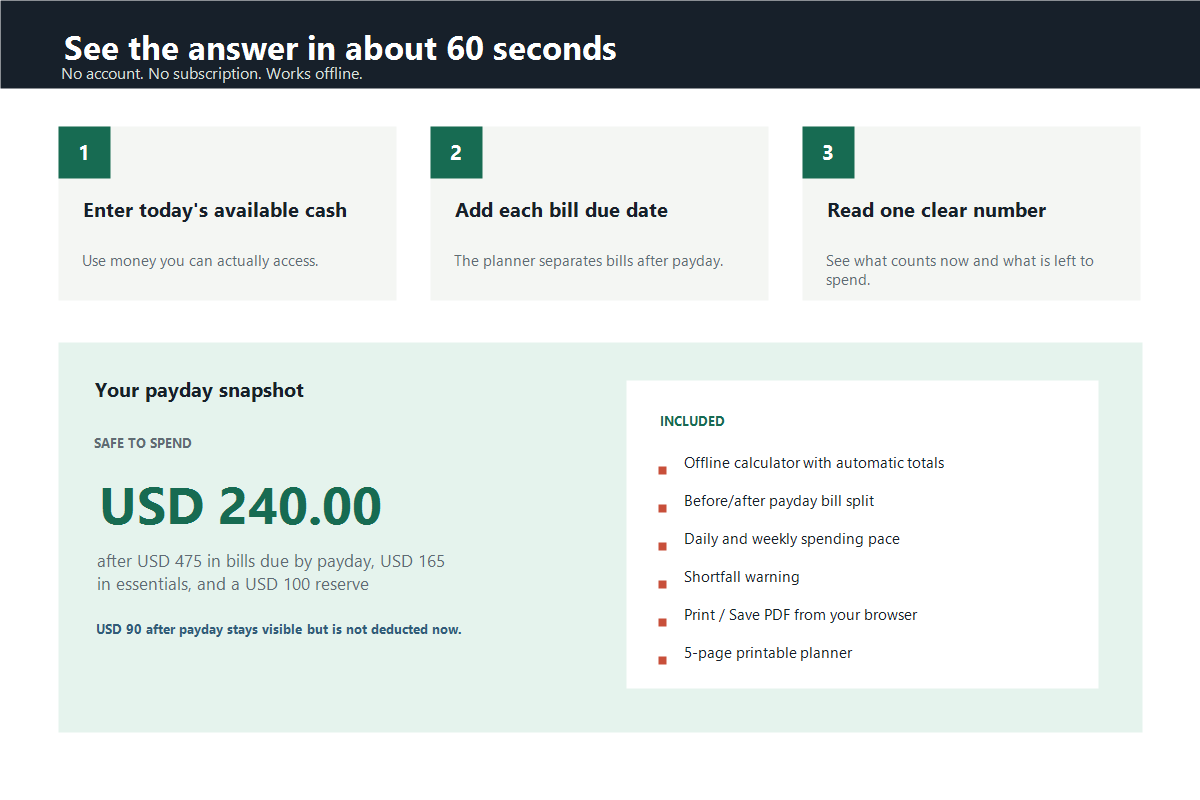
Suppose you have $980 today and payday is 10 days away.
- $475 in unpaid bills are due before payday.
- $90 insurance is due after payday.
- You still need $165 for groceries, transport, and medicine.
- You want to keep a $100 reserve.
For this pay period, the calculation is $980 - $475 - $165 - $100 = $240.
The $90 insurance bill should stay visible, but it is not part of the current-period subtraction because it falls after the next paycheck. It belongs in the following pay period.
Why due dates matter
A list of monthly bills tells you what you owe. A payday budget also tells you when each bill competes for the money currently available.
The CFPB's bill-calendar guidance recommends recording each bill, its amount, and its due date. If one week repeatedly contains more bills than income, the timing mismatch becomes visible.
Use four rules to keep the result honest
- Use spendable cash, not a credit limit. Credit is borrowed money, not income.
- Count bills without a clear date now. This is conservative until you confirm the date.
- Include realistic essentials. Groceries, transport, medicine, and other necessary costs still happen even when they are not formal bills.
- Treat the result as a ceiling, not a target. Spending less leaves more room for surprises.
What to do if the answer is negative
A negative result is a warning, not permission to ignore a required payment. Check every amount and due date first. Then separate flexible costs from required costs and contact providers early if you expect to miss a payment. Some providers may offer a different due date or payment arrangement, but terms and consequences vary.
For a fast four-number check, open the free live calculator. For individual bill dates and a second pay window, the Two-Payday Bill Planner performs the full calculation offline.
This article is for general educational organization only. It is not financial, legal, tax, debt, or payment advice. Verify every amount, due date, fee, and decision with the relevant provider.


Comments
Post a Comment