How to Split Bills Between Paychecks Without Treating Your Balance as Spendable Money
When a checking account shows $1,650, it is tempting to treat the whole balance as available. But part of that money may already belong to rent, bills, groceries, transport, medicine, and the days before the next paycheck.
The useful question is not, “What is my balance?” It is, “What must remain untouched before payday?”
The four amounts to protect first
Before deciding what is flexible, separate today’s money into four groups:
- Bills due before or on the next payday.
- Money this paycheck must set aside for rent.
- Essentials still needed before payday.
- A reserve you do not plan to use.
Subtract those groups from the money actually available today. What remains is the flexible amount before payday. Treat that result as a ceiling, not a target.
A $1,650 example
| Money available today | $1,650 |
| Bills due by payday | $475 |
| Rent set-aside | $500 |
| Essentials | $165 |
| Reserve | $100 |
| Protected total | $1,240 |
| Flexible before payday | $410 |
Keep the next paycheck separate
Do not add future income to today’s flexible amount. Instead, list the bills that land after the next payday but before the following payday. Then subtract those bills, that paycheck’s rent set-aside, essentials, and reserve from the expected deposit.
This keeps two different questions separate: what is safe to use now, and what the next paycheck must cover later.
Why a 35-day calendar helps
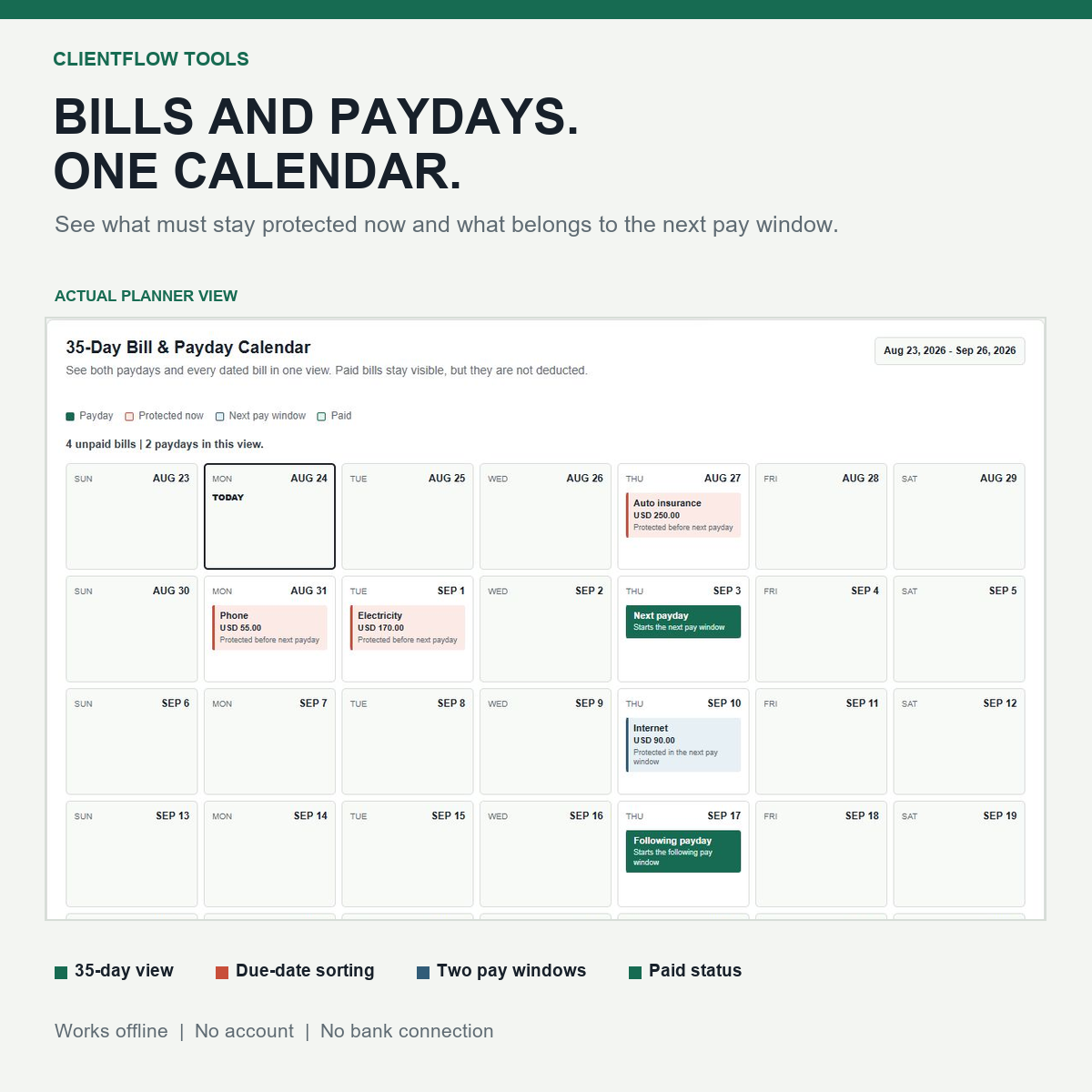
Put the next payday, the following payday, and every bill due date in one five-week view. You can see which bills belong to the current result and which belong to the next pay window without repeatedly scanning a monthly list.
Be conservative with bills due on payday. A matching date does not prove the paycheck will be usable before the bill is drafted. Confirm when payroll releases the money, when your bank makes it available, and when the biller takes the payment.
Try the date sorting for free
You can test the method with the free Bills by Paycheck Calculator. It shows which bills belong before the next payday and which belong to the following pay window.
Keep the full plan offline
The Paycheck Bill Planner adds rent set-asides, essentials, a reserve, paid status, local saving, backup and restore, a next-pay-window projection, the 35-day calendar shown above, and six printable pages. It is a one-time $7 download. Use WELCOME10 for 10% off.
This is an organization method, not financial or debt advice. Verify every amount, due date, pending transaction, and payment rule before making a decision.
When a checking account shows $1,650, it is tempting to treat the whole balance as available. But part of that money may already belong to rent, bills, groceries, transport, medicine, and the days before the next paycheck.
The useful question is not, “What is my balance?” It is, “What must remain untouched before payday?”
The four amounts to protect first
Before deciding what is flexible, separate today’s money into four groups:
- Bills due before or on the next payday.
- Money this paycheck must set aside for rent.
- Essentials still needed before payday.
- A reserve you do not plan to use.
Subtract those groups from the money actually available today. What remains is the flexible amount before payday. Treat that result as a ceiling, not a target.
A $1,650 example
| Money available today | $1,650 |
| Bills due by payday | $475 |
| Rent set-aside | $500 |
| Essentials | $165 |
| Reserve | $100 |
| Protected total | $1,240 |
| Flexible before payday | $410 |
Keep the next paycheck separate
Do not add future income to today’s flexible amount. Instead, list the bills that land after the next payday but before the following payday. Then subtract those bills, that paycheck’s rent set-aside, essentials, and reserve from the expected deposit.
This keeps two different questions separate: what is safe to use now, and what the next paycheck must cover later.
Why a 35-day calendar helps
Put the next payday, the following payday, and every bill due date in one five-week view. You can see which bills belong to the current result and which belong to the next pay window without repeatedly scanning a monthly list.
Be conservative with bills due on payday. A matching date does not prove the paycheck will be usable before the bill is drafted. Confirm when payroll releases the money, when your bank makes it available, and when the biller takes the payment.
Try the date sorting for free
You can test the method with the free Bills by Paycheck Calculator. It shows which bills belong before the next payday and which belong to the following pay window.
Keep the full plan offline
The Paycheck Bill Planner adds rent set-asides, essentials, a reserve, paid status, local saving, backup and restore, a next-pay-window projection, the 35-day calendar shown above, and six printable pages. It is a one-time $7 download. Use WELCOME10 for 10% off.
This is an organization method, not financial or debt advice. Verify every amount, due date, pending transaction, and payment rule before making a decision.


Comments
Post a Comment