How Much of a Monthly Bill Should Come From Each Biweekly Paycheck?
Splitting every monthly bill in half sounds tidy when you are paid every two weeks. But that advice mixes two different systems:
- Equal-transfer method: move a steady amount into a funded bills account every payday.
- Due-date method: reserve each unpaid bill from the paycheck that arrives before it is due.
Both can work. The right choice depends on whether the bill money is already available before the due date.
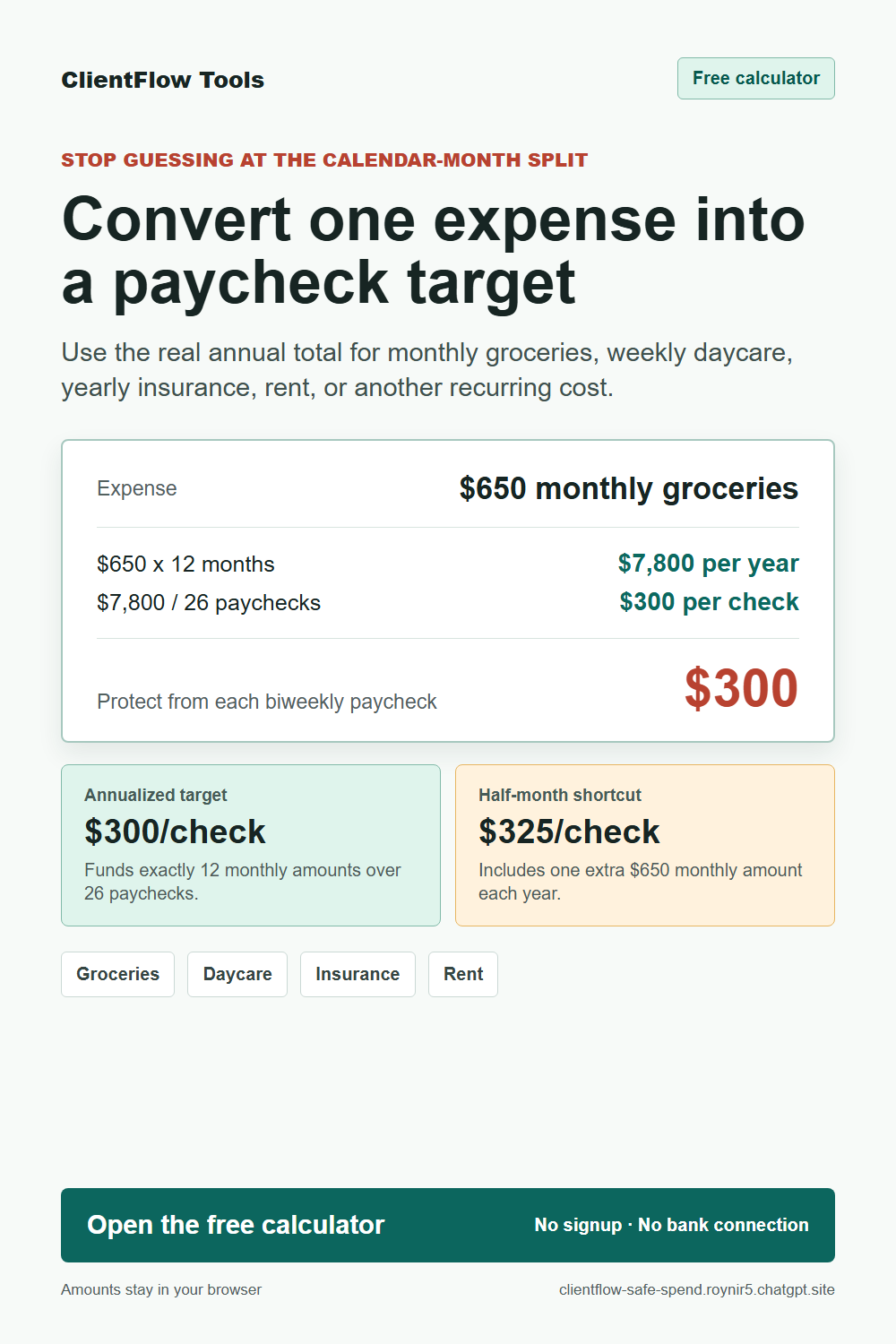
Quick example: $650 per month
With 26 biweekly paychecks, $650 x 12 / 26 is $300 per paycheck. Dividing the bill in half gives $325 per check and funds $8,450 over the year, one extra $650 monthly amount. That can be an intentional buffer, but it is different from the exact annual target.
Open the free monthly-bill to paycheck calculator to use your own amount and pay schedule. No signup or bank connection.
Biweekly is not the same as twice a month
A semi-monthly schedule normally produces 24 paychecks per year. A biweekly schedule, every 14 days, produces 26 paychecks in most years. That difference changes the math.
If predictable monthly bills total $2,000:
| Half of the monthly total | $1,000 per paycheck |
| Transferred over 26 biweekly paychecks | $26,000 |
| Twelve months of bills | $24,000 |
| Extra amount funded | $2,000 |
That extra $2,000 is not automatically bad. It can become a one-month bill buffer if that is the plan. The mistake is treating every biweekly check like one of exactly 24 checks without deciding what the two additional contributions are for.
For an even annual contribution, use:
Predictable monthly bills x 12 / expected paychecks
In this example, $2,000 x 12 / 26 is about $923.08 per biweekly paycheck. Recheck the number when a recurring bill changes, and keep variable bills separate or estimate them cautiously.
When splitting bills can work
An equal transfer is easiest when:
- The bills account already holds enough to pay anything due before the next transfer.
- The amounts are predictable.
- Variable bills have a separate cushion.
- You have a written rule for the extra-paycheck contributions.
This is a funding system. It works because the account has a buffer, not because every bill happens to be due halfway through the month.
When actual due dates should control
Use due dates first when the bills account starts near zero, income dates move, or a bill must be paid before the next equal contribution arrives.
Suppose the next paychecks arrive on August 7 and August 21:
| Bill | Due | Reserve from |
|---|---|---|
| Car insurance, $180 | August 12 | August 7 paycheck |
| Phone, $70 | August 25 | August 21 paycheck |
If there is no existing bill buffer, reserving only half of the $180 insurance bill on August 7 leaves it short before the August 21 paycheck. The current paycheck must protect the full unpaid amount due inside its window.
The Consumer Financial Protection Bureau's bill-calendar guidance recommends listing each bill, amount, and due date. Its cash-flow budget tool then compares the timing of income and expenses week by week.
A four-question decision test
- Is the bill already fully fundable before its due date? If not, assign the unpaid amount by date.
- Is the amount predictable? If not, use a cautious estimate and update it when the statement arrives.
- Are you paid biweekly or semi-monthly? Count the actual expected paychecks before choosing an equal transfer.
- Do you know what remains after the current bills? Calculate the present pay window before treating the rest as flexible.
Use the two methods in sequence
You do not have to choose one method forever. When cash is tight, assign bills by real due date so the next deadline is funded. As the bills account builds a reliable buffer, you can switch predictable monthly bills to an even transfer and keep the due-date list as a check.
The free converter works when you know one recurring amount and want an even per-paycheck target. The paid planner is for the different task of entering individual names, dates, and amounts, then separating them into the current and next pay windows.
When the current paycheck is not enough
A negative result means the money available now does not cover the bills, essentials, and reserve entered. It does not tell you which payment to delay or what consequence is acceptable.
The CFPB has a separate resource for prioritizing bills and contacting companies you owe. Verify deadlines, fees, assistance, and consequences directly for your situation.
Use the free monthly-bill to paycheck calculator to convert one recurring expense into a per-paycheck target. To sort individual bills into this paycheck and the next, use the Two-Payday Bill Planner.
This article is for general educational organization only. It is not financial, legal, tax, debt, or payment advice. Verify paycheck dates, bill amounts, due dates, balances, and assistance options yourself.


Comments
Post a Comment