Why Your Bank Balance Is Not Your Safe-to-Spend Number
Your bank balance answers one question: how much money is in the account right now. It does not automatically answer a different question: how much can you spend without taking money needed before payday?
That difference is why an account can look comfortable on Monday and still be short when bills clear on Thursday.
Turn the balance into a usable estimate.
Use the free live Safe-to-Spend Calculator. It runs in your browser without a signup or bank connection.
Part of the balance may already have a job
Before treating the balance as available spending money, account for:
- Unpaid bills due before the next paycheck
- Automatic payments that have not posted yet
- Card transactions or transfers still pending
- Groceries, transport, medicine, and other essentials needed before payday
- A reserve you intend to leave untouched
A practical safe-to-spend estimate is:
Current spendable cash + income before payday - bills due by payday - remaining essentials - reserve
A balance of $980 may mean $240 is flexible
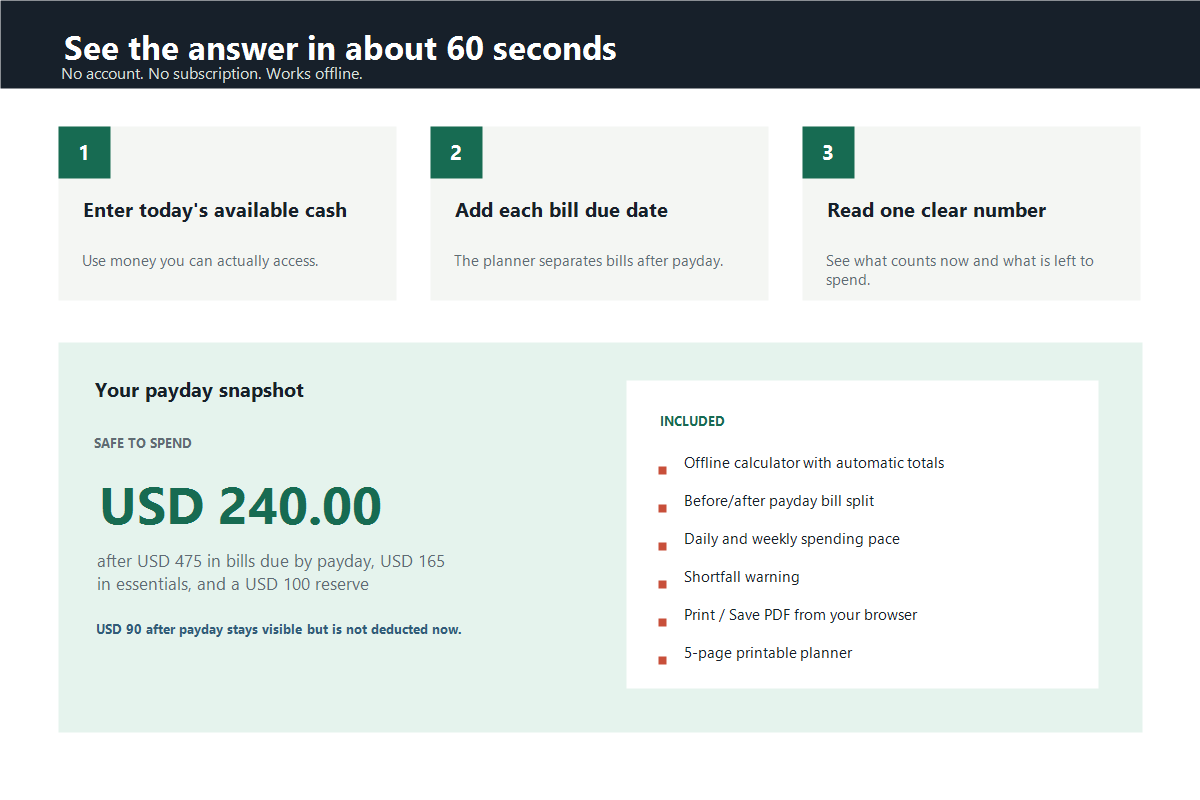
Consider this pay-period snapshot:
- $980 is currently available.
- $475 in bills is due before payday.
- $165 is still needed for essentials.
- $100 is protected as a reserve.
The flexible ceiling is $240, not $980.
If a $90 insurance payment is due after payday, it should remain visible for the next period but should not be subtracted from this one. That timing distinction keeps the estimate focused on the money that must last until new income arrives.
Reconcile pending transactions first
A calculator is only as accurate as the starting balance. Check whether card purchases, transfers, checks, or automatic payments are pending. Avoid counting money twice, especially when a payment appears in both your handwritten list and the bank's available-balance calculation.
Bank display conventions differ, so verify what your institution includes in "current" and "available" balances. The purpose of this step is not to predict exact posting times; it is to begin with the most realistic spendable amount you can confirm.
Turn the result into a pace
If $240 must last 10 days, the even daily pace is $24 and the seven-day pace is $168. These are check-in numbers, not spending targets. A no-spend day leaves more room later, and a necessary large purchase means the remaining pace should be recalculated.
The CFPB explains that cash flow is about the timing of money coming in and going out. Its cash-flow guidance notes that tracking this timing can reveal where a week or month runs short even when the broader budget appears workable.
Check the number again when something changes
Recalculate after a new bill, a changed due date, unexpected income, or a necessary purchase. Safe to spend is a current snapshot, not a permanent promise.
If the result is negative, verify the inputs and pause flexible spending. Do not use a negative result as a reason to ignore a required payment. Contact the relevant provider early to understand available options and consequences.
For a fast snapshot, open the free live calculator. If you need individual bill dates and the following paycheck forecast, use the Two-Payday Bill Planner.
This article is for general educational organization only. It is not financial, legal, tax, debt, or payment advice. Verify balances, pending transactions, due dates, and decisions yourself.


Comments
Post a Comment