A Worked Paycheck Budget: How $1,650 Becomes $410 Before Payday
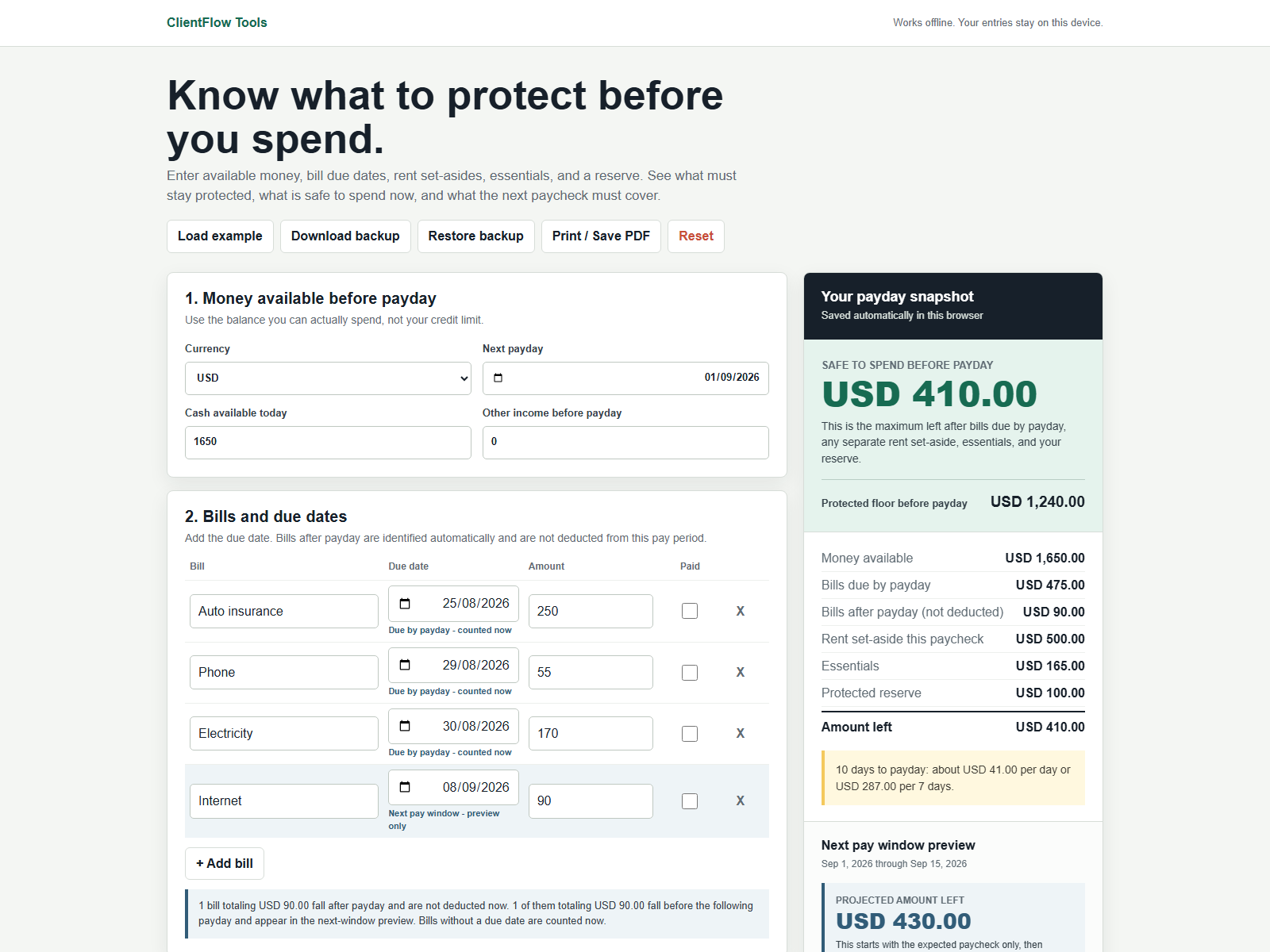
A bank balance answers one question: how much money is currently in the account. It does not answer a second question: how much of that money is still available after everything due before payday.
Take a $1,650 balance as an example. Before the next paycheck, three unpaid bills total $475. This paycheck also needs to set aside $500 for rent, cover $165 of essentials, and leave a $100 reserve. Those amounts add up to $1,240.
The complete calculation
$1,650 - $475 - $500 - $165 - $100 = $410
The result is $410 left before payday. It is not a goal to spend $410. It is the ceiling produced by this example after the known amounts have been separated.
Which bills belong in the $475?
A bill due before or on payday belongs to the current calculation if it has not already reduced the starting balance. A bill due after payday belongs to the next pay period.
Counting a payment twice makes the result too low. Leaving out an unpaid bill makes it too high. The dates matter as much as the subtraction.
Keep the next paycheck separate
A two-paycheck view prevents future income from making today's result look larger. It also shows which bills the next deposit must cover before any of that paycheck is treated as flexible.
The free worksheet lets you load this finished example, inspect the bill rows and totals, and then replace every number with your own. It runs in the browser, requires no signup or bank connection, and can be printed or saved as a PDF.
Open the free two-paycheck worksheet
When the full planner helps
If entering every recurring bill again each payday becomes the slow part, the full Paycheck Bill Planner adds weekly, every-two-weeks, and monthly repeats; automatic due-date placement; two separate pay windows; paid status; local saving; backup and restore; and a 35-day bill calendar.
See the actual Paycheck Bill Planner and the $7 one-time download. Use WELCOME10 for 10% off. There is no subscription or bank connection.
This example is for organization and education. Check the actual account balance, pending transactions, due dates, and payment timing before making a spending or payment decision.


Comments
Post a Comment