Rent Due Before Payday? Which Paycheck Should Cover It?
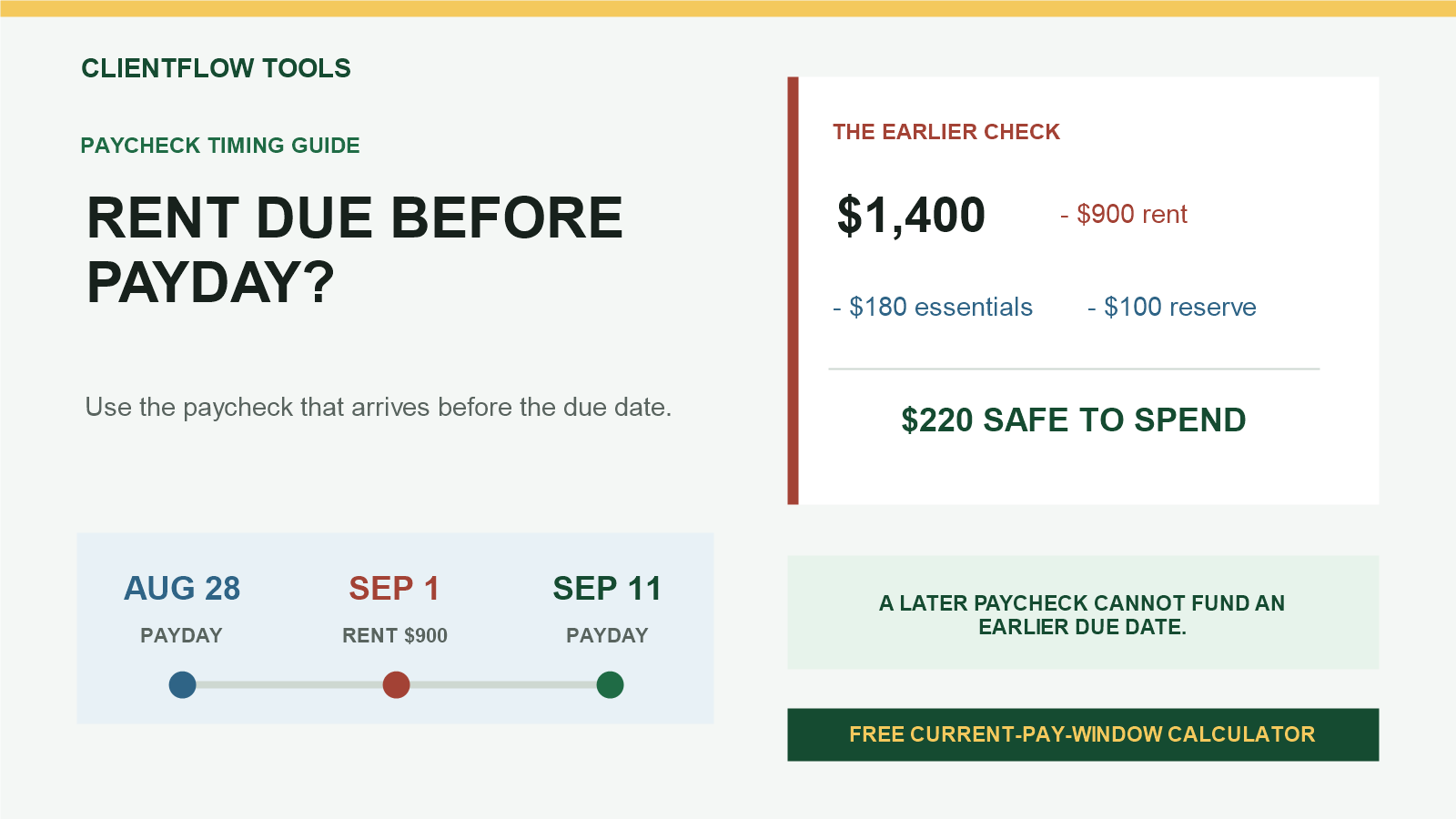
Rent is due September 1. Your paychecks arrive August 28 and September 11. Which paycheck must cover the rent?
The August 28 paycheck. The September 11 deposit arrives after the due date. A later paycheck cannot fund an earlier deadline.
Check your own rent date and paydays
The rule is simple, but the dates change from person to person. Use the free Rent Due Before Payday Checker to compare your rent deadline with your next two confirmed paydays. The result names the funding window; it does not connect to a bank or decide whether the payment is affordable.
Use the paycheck before the due date
Start with the real order of events, not a calendar-month total:
| Date | Event | Action |
|---|---|---|
| August 28 | Paycheck arrives | Reserve September rent |
| September 1 | $900 rent is due | Pay it from money already protected |
| September 11 | Next paycheck arrives | Use it for later obligations |
The Consumer Financial Protection Bureau's bill-calendar guidance recommends listing each bill, its amount, and its due date. Its cash-flow budget tool compares income and expenses by timing, not only by monthly totals.
A complete current-paycheck example
Suppose $1,400 is available after the August 28 paycheck:
| Money available | $1,400 |
| Rent due September 1 | -$900 |
| Essentials before the next payday | -$180 |
| Reserve left untouched | -$100 |
| Safe-to-spend estimate | $220 |
In one line: $1,400 - $900 - $180 - $100 = $220.
The bank balance may still show $1,400, but $900 is already committed to rent. Protecting it first prevents the rent money from looking available for unrelated spending.
Funding rent evenly across biweekly paychecks? A $900 monthly rent target is about $415.38 from each of 26 checks, not $450 from all 26. Read How Much of a Monthly Bill Should Come From Each Biweekly Paycheck? before choosing the transfer amount.
What if rent and payday are the same day?
Do not assume the deposit and withdrawal will be processed in the order you prefer. Deposit availability, automatic-payment timing, weekends, holidays, and bank processing rules vary. Verify the actual deposit availability and payment date with the bank and biller.
The CFPB notes that recurring electronic payments can still lead to overdraft or insufficient-funds fees when the account lacks available funds. Its overdraft guidance explains that recurring payments are treated differently from some debit-card transactions.
When the earlier paycheck is not enough
A negative calculator result is a shortage warning. It does not decide which payment to delay or what consequence is acceptable. Confirm the due date and amount, check whether the biller offers a due-date change or assistance, and understand fees or consequences before making a decision.
The CFPB provides a separate resource for prioritizing bills and contacting companies you owe.
Free calculator or bill-by-bill planner?
Use the free checker when you need to choose a paycheck for one bill. Use the paid planner when you have a full bill list and want individual names, amounts, and due dates sorted automatically into the current and next pay windows.
Run the free one-bill checker to match a due date to one of your next two paychecks. To sort individual bills by date across two paychecks, use the Two-Payday Bill Planner.
This article is for general educational organization only. It is not financial, legal, tax, debt, banking, or payment advice. Verify paycheck availability, bill amounts, due dates, balances, processing rules, and assistance options yourself.


Comments
Post a Comment