Which Bills Count Before Your Next Paycheck?
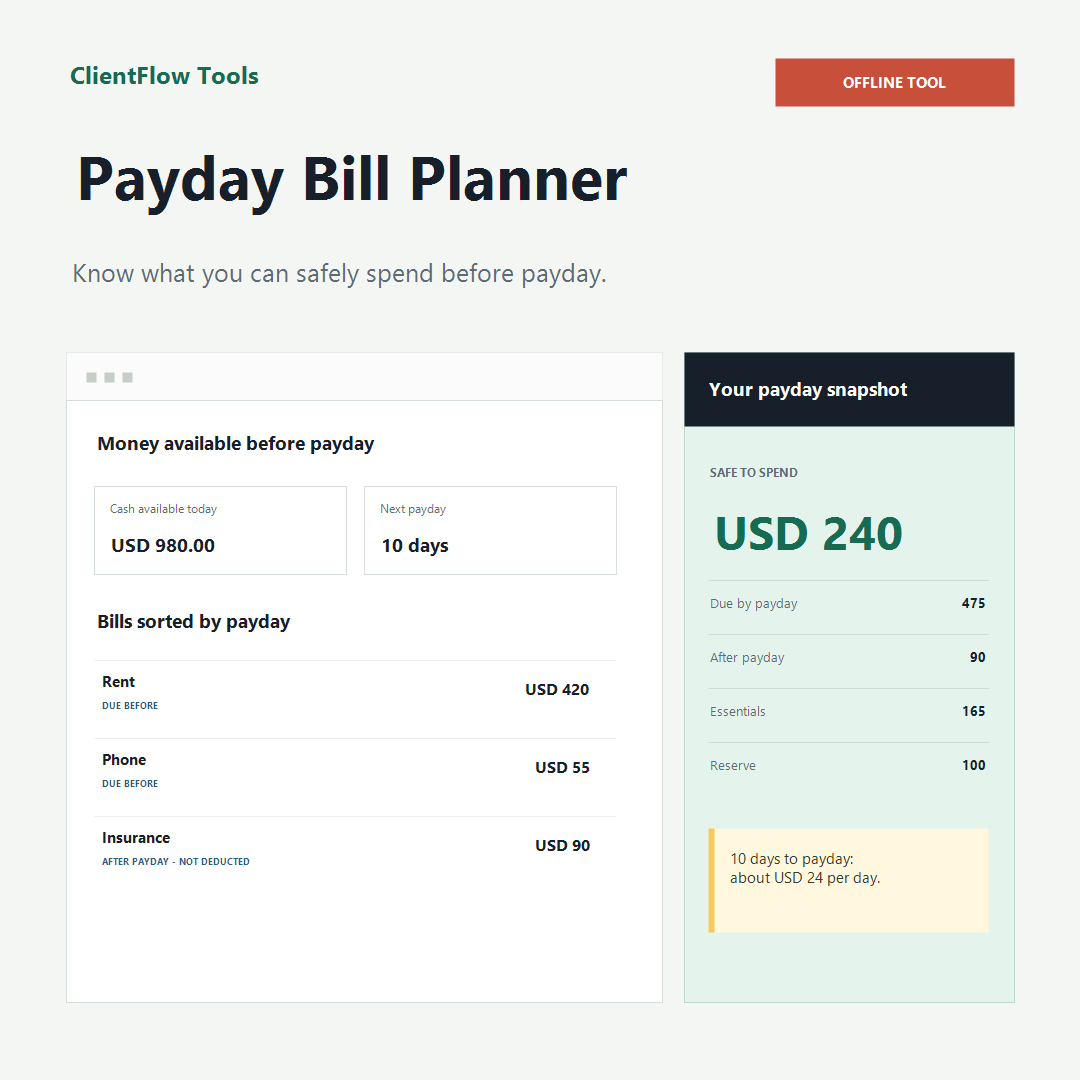
Your next paycheck is a useful dividing line. To know what the money in your account must cover, sort every unpaid bill into one of two groups: due by payday or due after payday.
This prevents two common errors: spending money that is already committed, and subtracting every future bill from the current pay period even when another paycheck arrives first.
Check the total before payday now.
Open the free live Safe-to-Spend Calculator. No signup, download, or bank connection is required.
The rule
If the bill must be paid on or before your next payday, count it now. If it is due after payday, keep it visible but place it in the next pay period.
A bill due on payday belongs in the current group. Payroll deposits can be delayed or posted at different times, while a payment can be collected early in the day. Counting it now is the safer assumption.
Count these before payday
- Rent, utilities, insurance, phone, loan, and card payments due on or before payday
- Automatic payments scheduled to leave before payday
- Any past-due amount that still must be handled
- Known essential costs before payday, such as groceries, transport, medicine, or childcare
- A bill with no confirmed due date, until you verify it
Keep these visible for the next period
- Bills with a confirmed due date after payday
- Subscriptions that renew after the next paycheck
- Planned costs that will not happen until the next pay period
Do not delete the second group. A bill after payday is still real. The point is to stop it from distorting the amount required before new income arrives.
Turning one monthly bill into a paycheck target? That is a separate calculation from deciding whether it is due before payday. Read How Much of a Monthly Bill Should Come From Each Biweekly Paycheck? to compare the exact annual target with the half-month shortcut.
Use the date money actually leaves
The statement date is not always the payment date. For automatic payments, use the date the provider is expected to debit the account. For payments you send yourself, allow enough processing time to arrive by the due date.
The CFPB's bill calendar tool recommends recording the date a payment must be sent or withdrawn, not merely the date printed at the top of a statement.
Example: one bill changes groups
Imagine payday is August 15:
- Phone bill, due August 10: count now.
- Rent, due August 15: count now.
- Insurance, due August 20: show after payday and do not deduct it from the current period.
- Medical bill, date unknown: count now until the date is confirmed.
If the insurance due date later changes to August 14, it must move into the current group. Recheck the list whenever a provider changes a due date or a new bill appears.
If one week is always overloaded
A repeating timing gap may be worth discussing with the biller. The CFPB reports that aligning some due dates with income flow can help consumers manage cash flow. A provider is not required to agree, and changing a date can affect the next statement, fees, or interest, so ask for the exact terms before accepting a change.
Use the free live calculator when you already know the total due before payday. Use the Two-Payday Bill Planner when you want individual due dates sorted into the current and next pay windows automatically.
This article is for general educational organization only. It is not financial, legal, tax, debt, or payment advice. Confirm due dates, processing times, fees, and payment consequences directly with each provider.


Comments
Post a Comment