Which Paycheck Should Pay Each Bill? A Two-Paycheck Example
When paychecks arrive every two weeks but bills use monthly due dates, one monthly budget total can hide the timing problem. The practical question is not only how much the bills cost. It is which paycheck must leave enough money for each bill before the next deposit arrives.
The simplest method uses three payday dates to define two complete pay windows. Paycheck 1 covers bills due after the first payday and through the second payday. Paycheck 2 covers bills due after the second payday and through the third payday. A bill due on payday should usually be protected by the earlier paycheck unless you have confirmed that the deposit posts before the bill is taken.
Try the free Bills by Paycheck Calculator. Enter your next three payday dates, two take-home amounts, and up to six bills. It returns both bill lists, both bill totals, and the amount left after those listed bills. No signup or bank connection is required, and the entered amounts remain in the current browser tab.
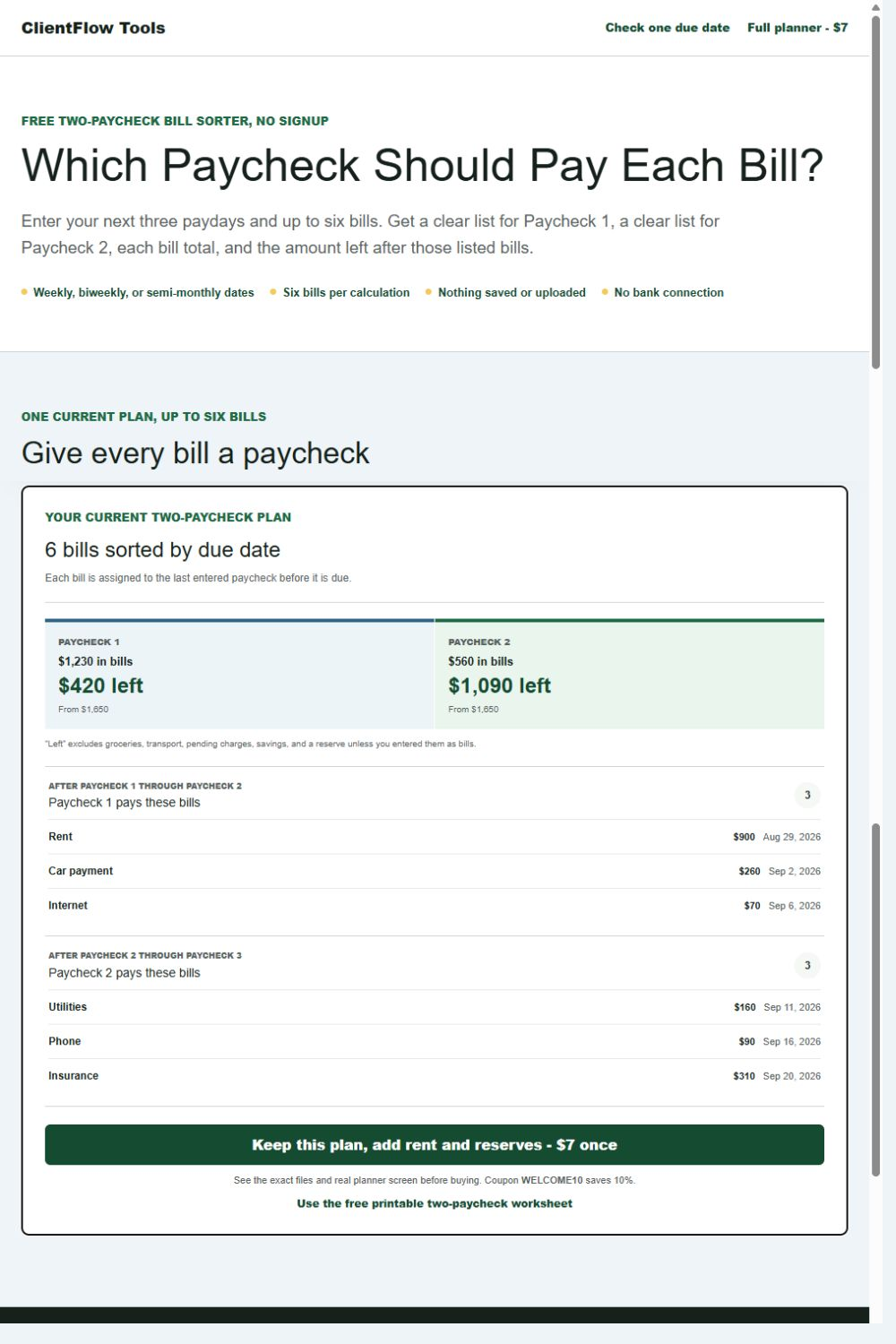
A two-paycheck example
Suppose the next two take-home paychecks are USD 1,650 each. The third payday is entered only to close the second pay window.
Bills after Paycheck 1 and through Paycheck 2
- Rent: USD 900
- Car payment: USD 260
- Internet: USD 70
- Total assigned to Paycheck 1: USD 1,230
- Amount left after those listed bills: USD 420
Bills after Paycheck 2 and through Paycheck 3
- Utilities: USD 160
- Phone: USD 90
- Insurance: USD 310
- Total assigned to Paycheck 2: USD 560
- Amount left after those listed bills: USD 1,090
The two checks have the same take-home amount, but they do not have the same bill load. That difference is easy to miss when every bill appears in one monthly list.
What to do when one paycheck is overloaded
First verify every due date and amount. Then ask the biller whether the due date can be changed, or start protecting part of the amount from an earlier paycheck. Do not assume a later deposit can cover an earlier automatic draft. A timing map does not prove that a bill is affordable; it only shows which money must be ready before the due date.
"Left" is not automatically safe to spend
The calculator subtracts only the bills entered. Groceries, transport, pending card charges, savings transfers, and a reserve may still have jobs. Review those items before treating the remainder as flexible money.
For a saved two-window plan with separate rent set-asides, essentials, a reserve, backup and restore, and a six-page printable worksheet, see the Two-Payday Bill Planner. It is USD 7 once, works offline, and does not connect to a bank. Coupon WELCOME10 saves 10%.
This is an educational planning method, not financial, legal, tax, or debt advice. Verify each deposit date, bill due date, amount, and posting rule before relying on the result.


Comments
Post a Comment